
Written By Pranisha Raniga, Speech Pathologist
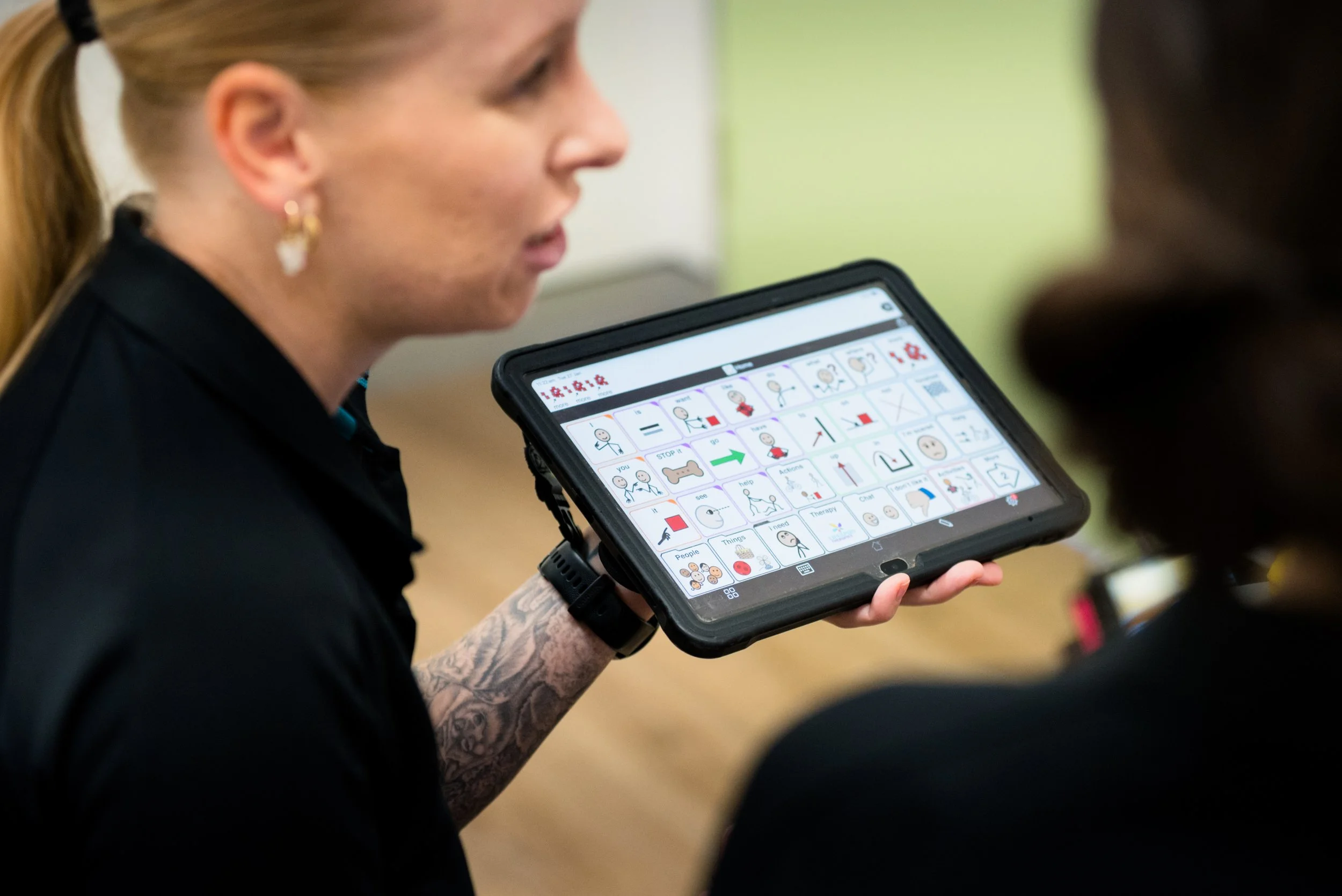
When we think about communication, we often think about talking. But communication is so much more than spoken words!
Think about someone pointing to something they want, shaking their head to say "no", sending a text message to a friend, or using a gesture to share something exciting. These are all meaningful ways of communicating, showing that we don't always need spoken words to get our message across.
For some people, using speech to communicate can be difficult, and they may need additional ways to express themselves. This is where Augmentative and Alternative Communication (AAC) can help.
What Exactly Is AAC?
AAC stands for Augmentative and Alternative Communication. It refers to the different ways people communicate alongside, or instead of, spoken language.
Augmentative means adding to or supporting speech.
Alternative means using another way to communicate when speech isn't available or isn't enough to get a message across.
AAC can help people of all ages express their wants, needs, thoughts, feelings and ideas, allowing them to communicate a wider range of messages and connect with others.
Importantly, AAC isn't just about asking for things! Communication is also about sharing stories, asking questions, making jokes, expressing opinions, saying "no" and building relationships.
Who Can Benefit From AAC?
AAC can support people with a wide range of communication needs, and the reasons for using it can differ from person to person.
AAC may be helpful for:
People who are not yet using spoken words.
People who use some speech but find it difficult to express more complex thoughts or ideas.
People whose speech is difficult for others to understand.
People who find speaking challenging in certain situations.
AAC can benefit people at any stage of life, from young children developing their communication skills to adolescents and adults. Some may use AAC temporarily, while others may rely on it as a long-term form of communication.
Importantly, there is no minimum age or specific set of skills someone must have before AAC can be introduced.
AAC is not "one-size-fits-all". A person might use spoken words, gestures, facial expressions and AAC tools at different times throughout their day. This is known as multimodal communication, where different ways of communicating work together to help someone express themselves and be understood.
What Does AAC Look Like?
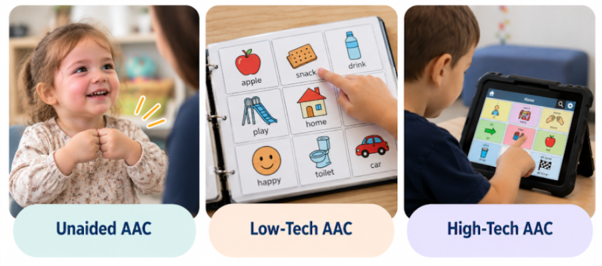
When people hear the term AAC, they often picture a tablet or electronic communication device. However, AAC comes in many different forms!
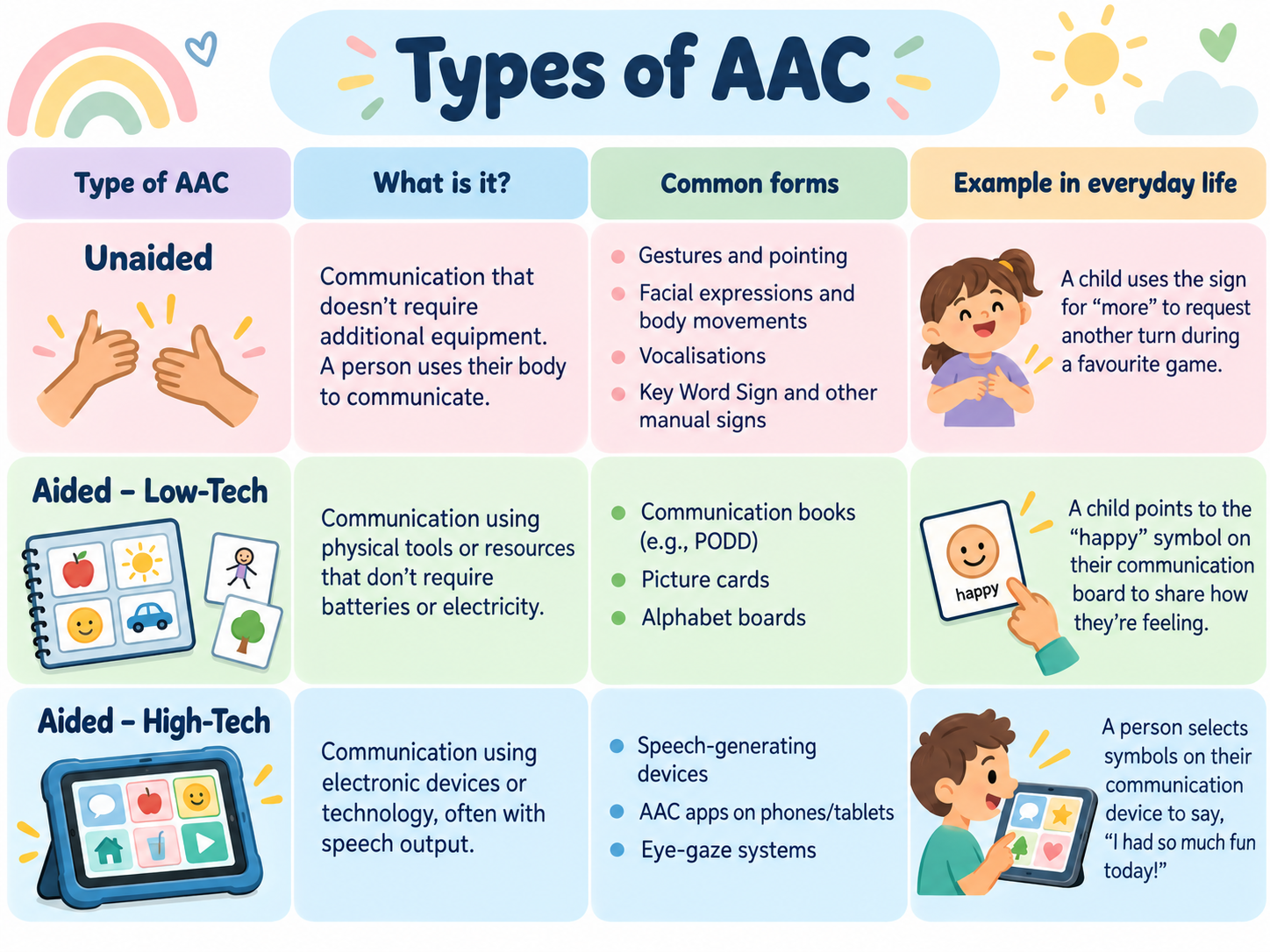
AAC is generally grouped into two main categories: unaided AAC and aided AAC. Aided AAC can be further divided into low-tech and high-tech options.
Let's Bust Some Common AAC Myths!
There are several common misconceptions about AAC that can leave individuals and families feeling unsure about whether it might be suitable for them or someone they care for.
Myth 1: "AAC is only for people who don't talk."
Fact: AAC can support people who already use spoken words! Someone may be able to communicate some messages through speech but need additional support to express more complex ideas or communicate when speech is difficult.
Myth 2: "Using AAC will stop someone from learning to talk."
Fact: Research has shown that AAC does not prevent speech development. In fact, for some people, AAC can also support the development of spoken language.
Myth 3: "AAC means using an iPad."
Fact: AAC includes much more than technology! Gestures, signs, picture boards and communication books are all forms of AAC. Electronic devices are just one of the many options available.
Myth 4: "We should wait and see if speech develops before introducing AAC."
Fact: AAC doesn't have to be a last resort. People can benefit from having access to different ways to communicate while their speech and language skills are developing. AAC can be introduced alongside speech and language development, rather than waiting to see whether speech develops on its own.
Communication Is About Connection
Communication is about more than getting a message across. It's about connecting with others, expressing who we are and participating in the world around us.
AAC can help make these connections possible by giving people more opportunities to express themselves, build relationships and take part in everyday experiences.
At Lifespan Therapies, we believe in empowering families to blossom through life. Our Speech Pathologists recognise that communication looks different for everyone and work alongside children and their families to explore communication approaches that suit their individual needs and strengths.
Because everyone deserves to be heard, no matter how they communicate.